Nick and I awoke at our usual early hour, 6 a.m. Being that this was a vacation, we were in no hurry to get up. Nick spent a few hours reading a Montalbano mystery on his Kindle, while I worked on my blog notes. Nicholas was struggling with jet lag, and Carla was preparing for an online conference that she would be part of the next day.
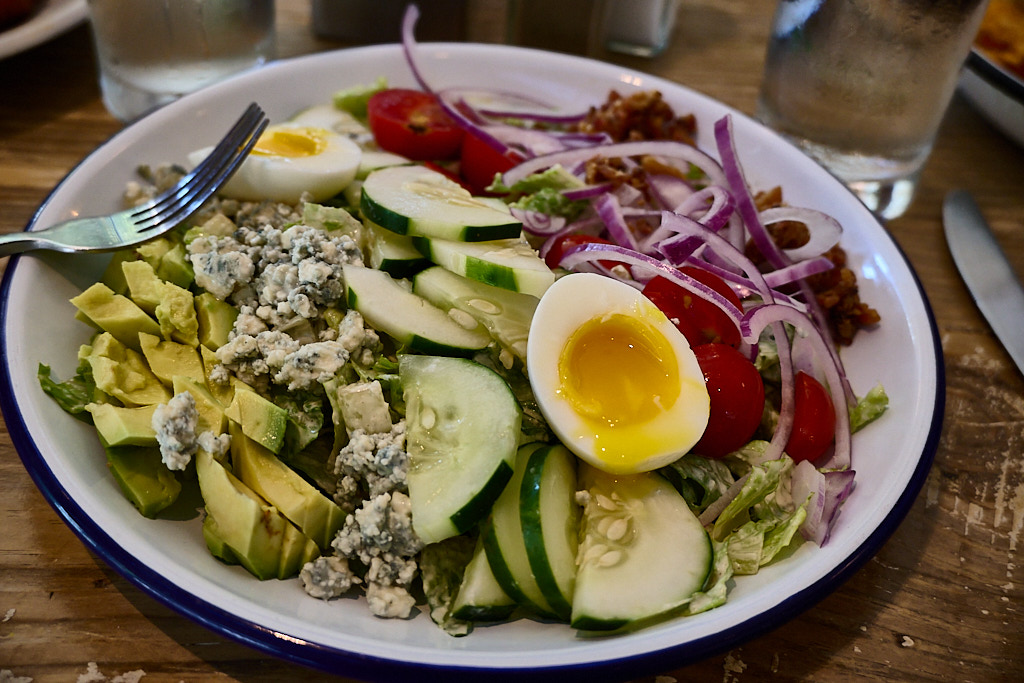
 At 11 a.m., hunger set in. We decided to take a streetcar to Debbie’s favorite breakfast place, called Willa Jean, for brunch. Carla ordered chicken salad on a croissant, Nicholas, a fried chicken sandwich, and Nick, a Cobb Salad that included avocado, bleu cheese, red onions, a soft boiled egg, cucumber, cranberries, and pecans. I chose a crab omelette with deep fried small potatoes. All of us were quite pleased with our choices!


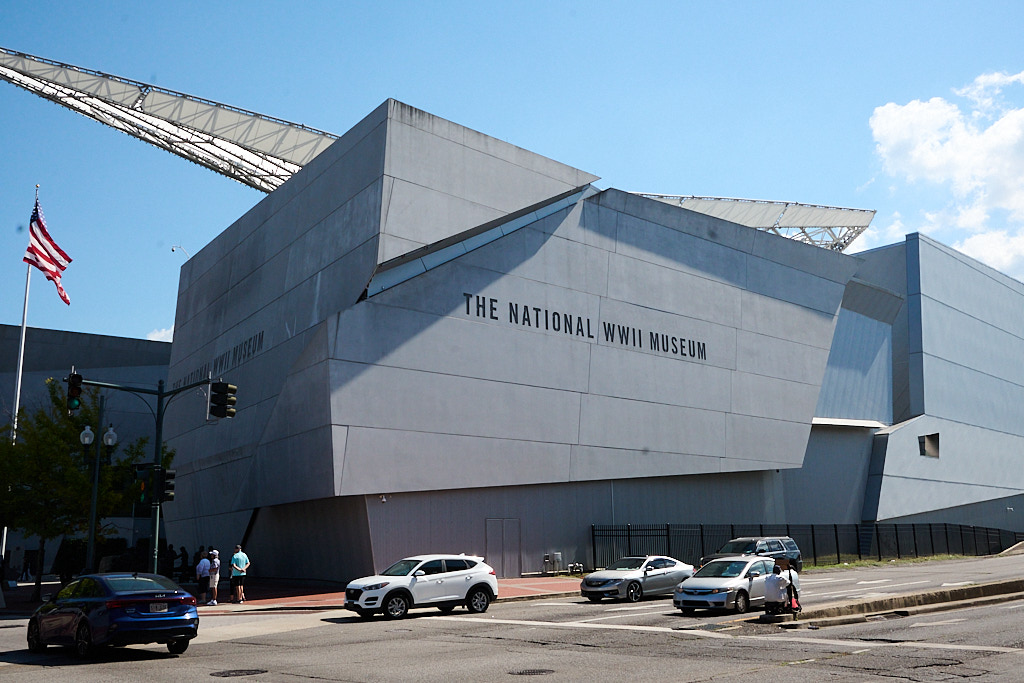 We were told that the World War II Museum was not to be missed, and it was close enough for us to walk there after our brunch. From the outside, the enormous set of buildings is amazing, and once inside, it is spectacular. The National WWII Museum tells the story of the American experience in the war that changed the world—why it
  was fought, and how it was won. The Museum is located in New Orleans because many of the ships that that were involved in the war, and some that took our infantrymen to Europe, were built in this city. We could have spent days exploring everything including the many photos and documents displayed there. Nick was impressed by a C-47 Skytrain, a plane that was used by the Allies for troop transport, cargo, paratrooper drops, glider towing, and military cargo parachute drops, that was suspended from the ceiling. He learned that it had been purchased by the Museum on eBay.
Nick’s uncle, Bob Stolfi, was a ball turret gunner on a B-17 bomber who flew missions over Italy. Sitting in the cramped underside of the airplane, he defended the vulnerable underside from attacks from the enemy. It was consider one of the most dangerous places on the plane.

Eventually there was an announcement that the museum would be closing in five minutes. Then Nicholas, who had gone ahead, ran back to tell me that he had seen a display about the Battle of Huertgen Forest. Just hearing that name made me shiver.
The Battle of Hürtgen Forest was a series of brutal, bloody, and lengthy engagements fought between American and German forces from September to December 1944. The battle, which became the longest ever fought on German soil by the U.S. Army, was characterized by terrible terrain, harsh weather, and heavy casualties on both sides, with Allied troops suffering tens of thousands of losses in a costly attempt to advance through the dense woods.
The forest, combined with heavy rain, sleet, snow, and mud, created a nightmarish battlefield that negated Allied advantages in mobility and armor. The terrain offered the Germans excellent defensive positions, and “tree bursts”—explosions that sent shrapnel and wood splinters down on troops—were particularly deadly. Many of the soldiers died from pneumonia or frostbite rather than battle wounds. The forest was strategically important because it provided cover for German forces and controlled access to the Rur River dams, making it a crucial battleground for the Germans.
I have never met anyone who has heard of the Battle of Huertgen Forest. For my family, it was deeply significant, because my father, Steve Nucatola, who was drafted into the Army at the age of thirty-three, was there. I had never seen photos of the forest before, and it looked exactly as my dad described it, a great many tall trees packed densely together, creating darkness day and night.
On October 25, 1944, my dad was ordered to relieve a scout who was near enemy territory. Dad crawled along on his belly to reach the young soldier. My dad told me that he thought of that scout and the relieved look on his face when my dad replaced him, every day, since October 25, 1944.
Shortly after the scout crawled back to the Army encampment, enemy artillery bombarded it, taking the lives of all of the Americans at the camp, including the soldier who thought he had crawled back to safety. Meanwhile, my dad became a victim of a “tree burst.”  A sniper who was high up in one of the tall trees was shooting at him, and shrapnel landed in my dad’s face. Thankfully, he was found by another group of Allies. He suffered from PTSD, which was not identified at that time. Fortunately, he returned to the USA. Had he not survived the battle, I and my younger brothers would not have been born.
Amazing history of your father! Wonderful family adventures for the four of you!
A beautiful tribute to your father, Barbara.
I had never heard about your father’s experience in the war, Barbara! That’s quite a story!
Also, I didn’t know so many ships had been built in New Orleans.
It’s so nice to relive these memories!